
Challenge

Holy Cross College wanted to increase student retention rates and were exploring various innovative approaches to increase engagement. To plan effectively, they needed to understand how students made the choice to return to HCC and how the school compared to competing options.

Solution

Holy Cross College partnered with Vennli, whose software and services improve strategic decisions by making it easy to understand how students make choices. Using the integrated survey platform, Holy Cross College easily gathered real-time insights about what’s most important to students and how they choose between available options. Intuitive data visualization quickly lead to decisions aligned with student needs.

Key Insights to Drive Actions

Leadership at Holy Cross College hypothesized that the greater the difference between student expectations about college and the student experience at Holy Cross College, the greater the attrition.  Similarly, they expected that the greater the difference between student perceptions of Holy Cross College and student perceptions about the experience at other colleges, the greater the attrition. With us, they tested these assumptions with over 50% of their freshman and sophomore students, and learned that they held true but only for unique segments of students, which had a significant impact on their planning.

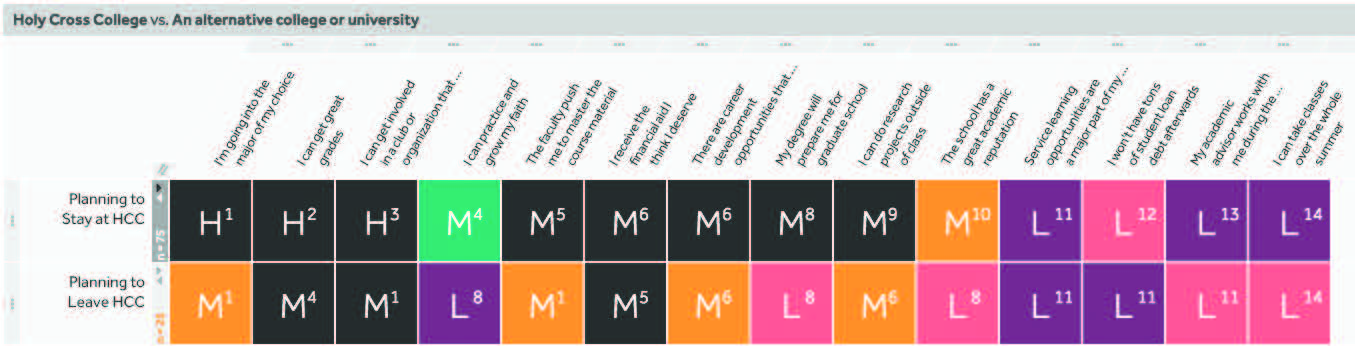
In general, students did not differentiate much between Holy Cross College and other institutions (i.e. most factors fell into the Gray Zone, indicating an opportunity to build competitive advantage). The most important choice factors to students were 1) availability of desired academic majors, 2) ability to achieve good grades, and 3) opportunity to be involved with clubs and organizations.

Another surprise was that more than 50% of their freshmen and sophomores are working while going to school and a third are volunteering.

Analytics uncovered four different segments of students, which really illuminated the path to increasing engagement.

• The first segment was at higher risk of attrition due to associating academic factors more strongly with other schools.
• The second and third segments represented Holy Cross College’s core students – they were fully engaged and had positive perceptions of HCC.
• The fourth segment was disengaged and unlikely to return in the fall due to a poor fit with Holy Cross College.

In general, the student-reported retention intention was much higher than expected, which was excellent news. Those planning to transfer reported that academic related factors were higher in importance, and they associated those factors more with transfer schools.
Results

Holy Cross College had been considering making large investments to increase student engagement, including hiring summer faculty to interact with students and a smartphone app increase communication about activities. However, respondents reported low interest in summer interaction and strong awareness of campus activities through existing forums, allowing HCC to redirect these dollars. Armed with these insights, the leadership team moved quickly and began innovating to increase student retention. Instead of making costly changes to their faculty structure, they will revamp their honors program, implement new seminars and research opportunities, and invest in hiring more PhD faculty. They are also considering investing in a student activities director to increase social engagement – an unmet student need uncovered during the segmentation analysis. With the knowledge that more students plan to return in the fall than the college expected, the leadership team was able to act quickly and confidently to implement an engagement strategy that came directly from the voice that matters most – their students.

Want to learn more?

Sign up for our newsletter
Free ‘Global Real Estate Company’ case study

Get a free printable copy of this case study.